Stay informed
Newsletters
Understanding Vertical AI and Multi-Agent Systems
Date:
Feb 24, 2025
What is Vertical AI?
Vertical AI refers to artificial intelligence applications that are specifically designed to address the unique challenges of particular industries, such as healthcare, finance, and retail. Unlike traditional horizontal AI, which offers general-purpose solutions applicable across various sectors, Vertical AI leverages deep industry knowledge and domain-specific data to deliver tailored solutions. This specialization allows businesses to optimize workflows and improve outcomes significantly.
Key Characteristics of Vertical AI:
Industry-Specific Focus: Tailored to meet the needs of specific sectors.
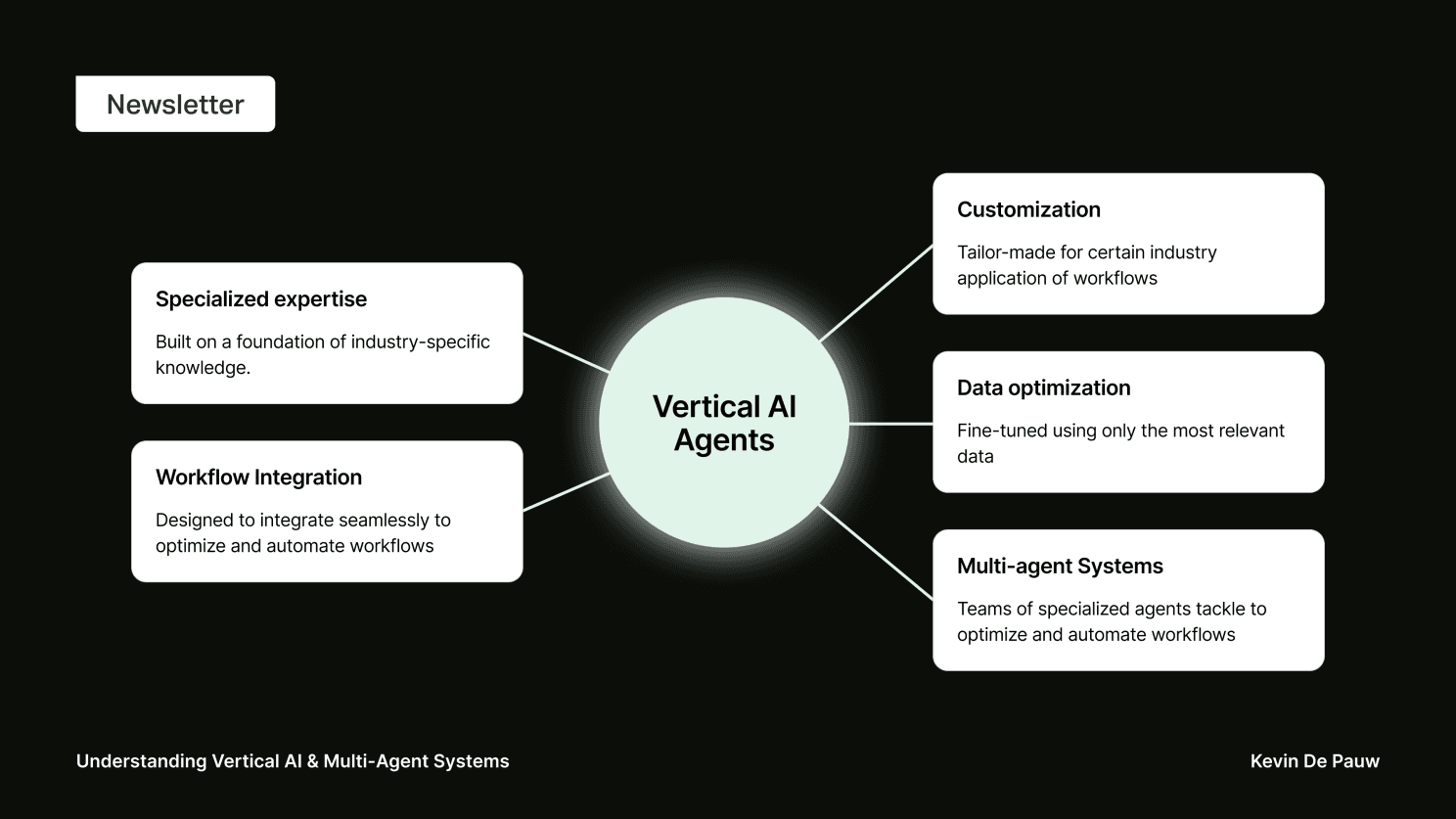
Customization: Solutions are fine-tuned for particular applications, enhancing their effectiveness.
Data Optimization: Utilizes specialized datasets for training, leading to improved accuracy and performance.
For example, in healthcare, Vertical AI can assist with patient data management and diagnostics, while in finance, it enhances compliance monitoring and risk assessment. Such targeted applications not only streamline operations but also reduce costs and improve service delivery.
The Rise of Vertical AI Agents
Building on the foundation of Vertical AI are Vertical AI Agents—intelligent systems designed to automate industry-specific tasks. These agents integrate seamlessly into existing workflows and can handle complex processes that traditionally required human intervention. Their ability to understand the nuances of their respective industries allows them to deliver highly accurate results efficiently.
IMAGE 1 -
Content 2 -
Applications Across Industries:
Healthcare: Automating patient record management and diagnostics.
Finance: Enhancing fraud detection and compliance monitoring.
Customer Support: Streamlining ticketing systems and automating responses.
Retail: Optimizing inventory management and personalized marketing strategies.
As organizations increasingly adopt these specialized agents, they discover that they can outperform conventional Software-as-a-Service (SaaS) models by providing immediate returns on investment through enhanced efficiency [2][5].
Multi-Agent Systems: Collaborative Intelligence
Multi-Agent Systems (MAS) represent another layer of innovation in AI. These systems consist of multiple intelligent agents that collaborate or compete to achieve specific goals. The collaborative nature of MAS allows for sophisticated problem-solving capabilities across various domains—from traffic management to resource allocation in e-commerce.
Key Features of Multi-Agent Systems:
Decentralized Control: Each agent operates independently while contributing to a collective objective.
Real-Time Optimization: Agents can adapt their strategies based on environmental feedback.
Scalability: MAS can be expanded easily by adding new agents without disrupting existing operations.
For instance, in urban traffic management, multiple agents can work together to optimize traffic flow in real-time, significantly reducing congestion.
The Future Landscape
Looking ahead, both Vertical AI and Multi-Agent Systems are poised for significant growth. Emerging trends such as multimodal capabilities—where systems integrate various data types—and the development of robust integration ecosystems will enhance their effectiveness. As businesses seek more sophisticated solutions that can process complex information seamlessly, these technologies will become increasingly valuable.
Moreover, the potential for automation within Vertical AI suggests a future where many routine tasks could be handled by intelligent agents at a fraction of current costs. This shift not only promises operational savings but also allows human resources to focus on strategic initiatives rather than mundane tasks.
The convergence of Vertical AI and Multi-Agent Systems marks a significant advancement in how industries leverage artificial intelligence. By embracing these technologies, organizations can drive innovation, enhance operational efficiency, and position themselves at the forefront of their respective fields. As we continue to explore these developments, it is clear that the future belongs to those who harness the power of specialized AI solutions tailored to meet their unique challenges.