Stay informed
Newsletters
The Protocol Battle Shaping the Future of AI Agents: ACP vs A2A vs MCP
Date:
Jun 30, 2025
What’s new? As of mid-2025, the AI community is converging on these three key protocols, each solving a distinct piece of the puzzle:
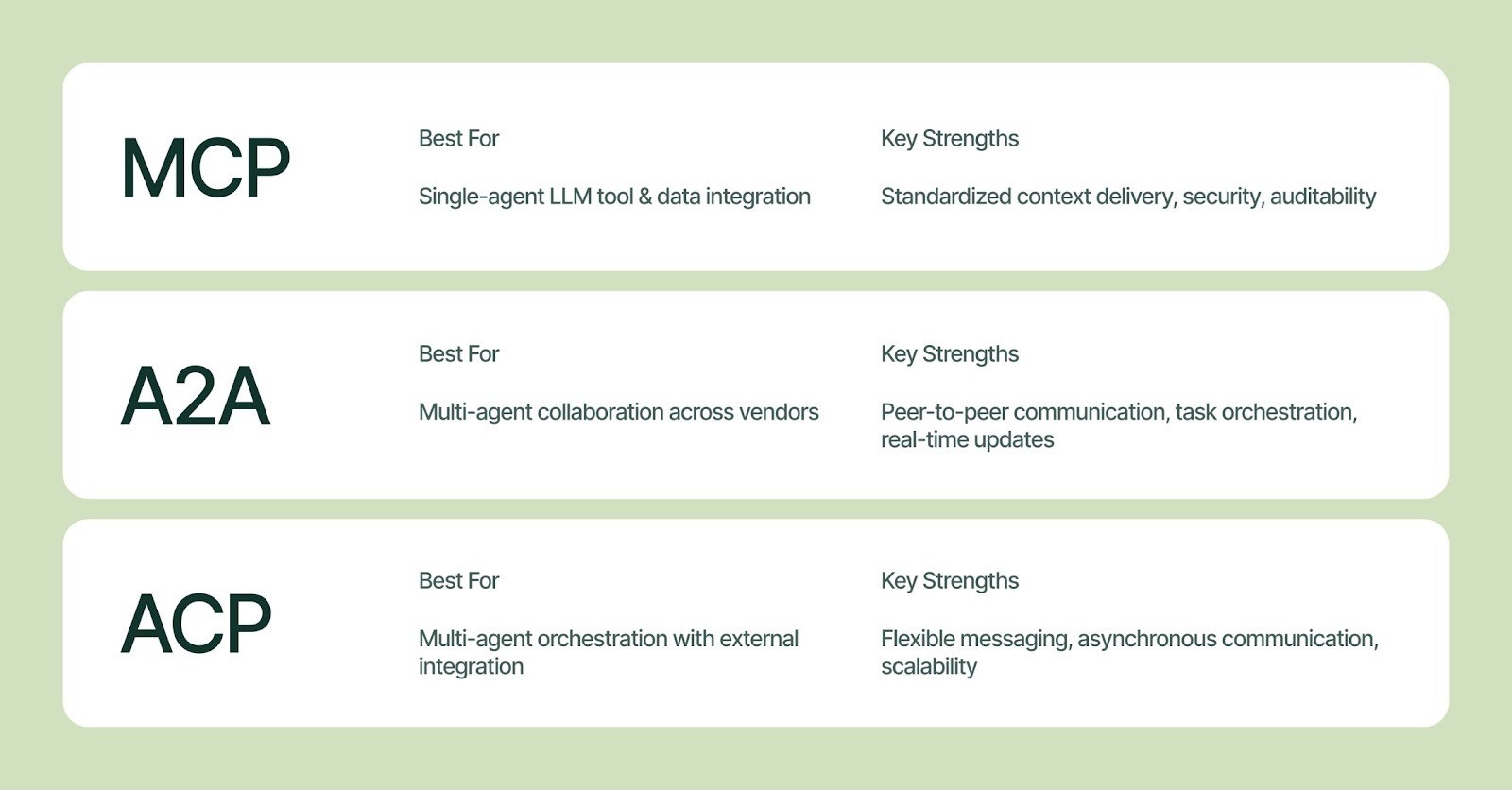
Model Context Protocol (MCP) — Dubbed the “USB-C port for AI” by Anthropic, MCP standardizes how large language models (LLMs) access external data sources and tools. It excels in securely piping context and functions into LLM workflows, perfect for single-agent scenarios requiring rich, controlled data integration.
Agent-to-Agent Protocol (A2A) — Focused on direct peer-to-peer communication, A2A enables specialized AI agents from different vendors or platforms to collaborate and coordinate tasks dynamically. It shines in multi-agent workflows needing deep inter-agent negotiation, such as IT operations or supply chain management.
Agent Communication Protocol (ACP) — Emerging from IBM’s BeeAI project, ACP builds on MCP’s foundation to facilitate flexible, brokered communication among multiple agents and external systems. It supports asynchronous, streaming, and multimodal messaging, making it ideal for complex, real-world AI ecosystems requiring dynamic delegation and orchestration.
Why does this matter?
The fragmentation in AI protocols today mirrors the pre-USB era of computing, where every device had its own connector. MCP, A2A, and ACP represent a coordinated industry effort to unify AI agent communication, reduce integration overhead, and enhance interoperability across platforms and domains. Without such standards, AI agents risk becoming siloed, limiting their ability to collaborate effectively and scale across diverse environments.
Deepening the understanding of each protocol MCP’s strength lies in its client-server architecture, providing a secure, stateless interface that allows LLMs to invoke external tools and retrieve data seamlessly. This makes it indispensable for applications where a single AI agent needs to augment its capabilities with external knowledge or specialized functions.
In contrast, A2A’s peer-to-peer model facilitates direct agent-to-agent communication, enabling dynamic task delegation and negotiation. This is particularly valuable in scenarios where multiple autonomous agents must coordinate complex workflows without relying on a central broker, such as in distributed IT management or collaborative robotics.
ACP, meanwhile, introduces a brokered client-server architecture with session awareness and run-state tracking, supporting multi-turn, asynchronous conversations. Its modular design and MIME-typed multipart messaging enable rich, multimodal interactions, making it well-suited for enterprise-grade automation where agents must interact with both humans and other systems reliably and at scale.
When to use which?
IMAGE 1 -
Content 2 -
Insights from the latest discussions
In LuminaTalks podcast, IBM researchers Sandi Besen and Aakriti Aggarwal highlighted ACP’s role as the “HTTP for AI agents,” enabling agents to communicate and negotiate complex workflows dynamically. This aligns with recent analyses emphasizing ACP’s brokered client-server architecture and MIME-typed multipart messaging for rich interactions.
Meanwhile, MCP remains the go-to for securely connecting LLMs with diverse data and tools, and A2A excels in enabling specialized agents to coordinate tasks in distributed environments. Each protocol reflects a different design philosophy and use case, underscoring the importance of selecting the right tool for your AI architecture.
Looking ahead
As these protocols mature, expect them to complement rather than replace each other—forming layered stacks that empower resilient, scalable AI agent ecosystems. Enterprises and developers should assess their specific needs, such as whether their agents require direct peer communication, tool integration, or complex orchestration involving multiple parties.
The future will likely see hybrid implementations where MCP handles secure tool access, ACP manages brokered multi-agent workflows, and A2A facilitates real-time peer collaboration. This layered approach will unlock new possibilities in AI-driven automation, compliance, and digital trust frameworks.
Get involved and stay informed
For those interested in exploring these protocols further, the podcast episode offers an in-depth discussion with leading IBM researchers and practical insights on deploying ACP alongside MCP and A2A. Staying current with these developments is crucial as AI agent ecosystems become foundational to enterprise innovation.
Listen to the full episodehere and join the conversation on how these protocols are shaping the future of AI communication.What’s new? As of mid-2025, the AI community is converging on these three key protocols, each solving a distinct piece of the puzzle:
Model Context Protocol (MCP) — Dubbed the “USB-C port for AI” by Anthropic, MCP standardizes how large language models (LLMs) access external data sources and tools. It excels in securely piping context and functions into LLM workflows, perfect for single-agent scenarios requiring rich, controlled data integration.
Agent-to-Agent Protocol (A2A) — Focused on direct peer-to-peer communication, A2A enables specialized AI agents from different vendors or platforms to collaborate and coordinate tasks dynamically. It shines in multi-agent workflows needing deep inter-agent negotiation, such as IT operations or supply chain management.
Agent Communication Protocol (ACP) — Emerging from IBM’s BeeAI project, ACP builds on MCP’s foundation to facilitate flexible, brokered communication among multiple agents and external systems. It supports asynchronous, streaming, and multimodal messaging, making it ideal for complex, real-world AI ecosystems requiring dynamic delegation and orchestration.
Why does this matter?
The fragmentation in AI protocols today mirrors the pre-USB era of computing, where every device had its own connector. MCP, A2A, and ACP represent a coordinated industry effort to unify AI agent communication, reduce integration overhead, and enhance interoperability across platforms and domains. Without such standards, AI agents risk becoming siloed, limiting their ability to collaborate effectively and scale across diverse environments.
Deepening the understanding of each protocol MCP’s strength lies in its client-server architecture, providing a secure, stateless interface that allows LLMs to invoke external tools and retrieve data seamlessly. This makes it indispensable for applications where a single AI agent needs to augment its capabilities with external knowledge or specialized functions.
In contrast, A2A’s peer-to-peer model facilitates direct agent-to-agent communication, enabling dynamic task delegation and negotiation. This is particularly valuable in scenarios where multiple autonomous agents must coordinate complex workflows without relying on a central broker, such as in distributed IT management or collaborative robotics.
ACP, meanwhile, introduces a brokered client-server architecture with session awareness and run-state tracking, supporting multi-turn, asynchronous conversations. Its modular design and MIME-typed multipart messaging enable rich, multimodal interactions, making it well-suited for enterprise-grade automation where agents must interact with both humans and other systems reliably and at scale.
When to use which?
IMAGE 1 -
Content 2 -
Insights from the latest discussions
In LuminaTalks podcast, IBM researchers Sandi Besen and Aakriti Aggarwal highlighted ACP’s role as the “HTTP for AI agents,” enabling agents to communicate and negotiate complex workflows dynamically. This aligns with recent analyses emphasizing ACP’s brokered client-server architecture and MIME-typed multipart messaging for rich interactions.
Meanwhile, MCP remains the go-to for securely connecting LLMs with diverse data and tools, and A2A excels in enabling specialized agents to coordinate tasks in distributed environments. Each protocol reflects a different design philosophy and use case, underscoring the importance of selecting the right tool for your AI architecture.
Looking ahead
As these protocols mature, expect them to complement rather than replace each other—forming layered stacks that empower resilient, scalable AI agent ecosystems. Enterprises and developers should assess their specific needs, such as whether their agents require direct peer communication, tool integration, or complex orchestration involving multiple parties.
The future will likely see hybrid implementations where MCP handles secure tool access, ACP manages brokered multi-agent workflows, and A2A facilitates real-time peer collaboration. This layered approach will unlock new possibilities in AI-driven automation, compliance, and digital trust frameworks.
Get involved and stay informed
For those interested in exploring these protocols further, the podcast episode offers an in-depth discussion with leading IBM researchers and practical insights on deploying ACP alongside MCP and A2A. Staying current with these developments is crucial as AI agent ecosystems become foundational to enterprise innovation.
Listen to the full episodehere and join the conversation on how these protocols are shaping the future of AI communication.