Stay informed
Newsletters
The Hidden System That Holds Everything Together
Date:
May 5, 2025
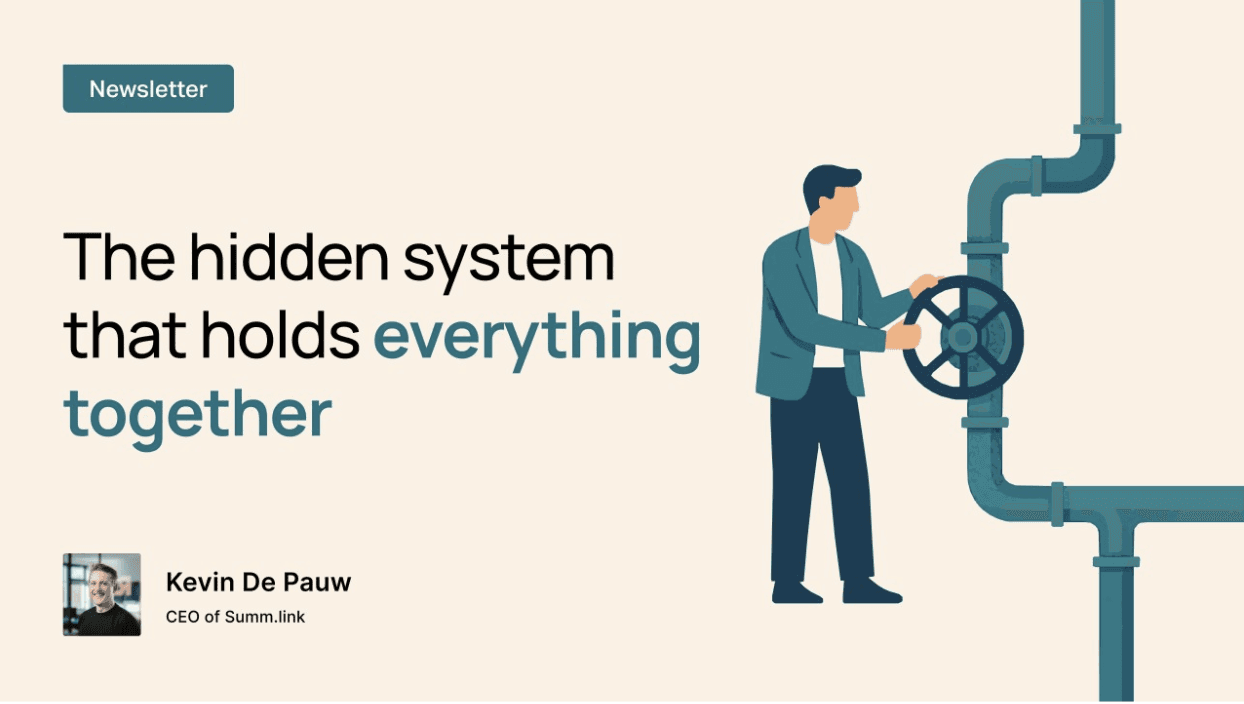
As I’ve built Summ.link and spoken with founders, CTOs, and enterprise leaders, one thing has become clear: most people hear “data governance” and think of bureaucracy, red tape, or a checkbox exercise for compliance. But the truth? Strong data governance is one of the most strategic investments a company can make.
What Is Data Governance, Really?
Let’s drop the jargon for a second. Think of your company’s data as water—flowing through pipes (your systems), powering machines (your teams), and fueling daily operations (decisions, reporting, automation). Data governance is the infrastructure that:
Keeps the water clean (accuracy and security)
Makes sure it flows where it should (access control and usage policies)
And prevents leaks or contamination (risk management and compliance)
Without that structure, you’re not just vulnerable—you’re inefficient.
“You Can’t Retrofit Good Governance”
A while ago, Marc Dekeyser shared something that stuck with me:
“Compliance shouldn’t be an afterthought it needs to be integral from day one.”
Too many companies try to install plumbing after the building’s already up. By then, it’s expensive, slow, and disruptive. Startups often push governance aside, hoping to "deal with it later." But later means:
Costly re-platforming
Painful data migrations
Legal headaches (hello, GDPR fines)
Lost trust from users, partners, and investors
A Real-World Warning: British Airways
Remember when British Airways was fined £20 million after a breach exposed 400,000+ customer records? It wasn’t just a security issue. It was a governance failure—a sign that the plumbing wasn’t built right from the start.
You can’t blame the water for flooding if the pipes weren’t installed properly.
📎 Read more about the BA fine →
You don’t need a compliance department the size of a law firm. Here’s how I advise companies—especially fast-growing ones—to approach data governance:
1. Start small, but early
Use tools like Collibra or Informatica to map your data from day one. Don’t wait until you’re scaling to organize your house.
2. Assign clear roles
Treat data like any other critical asset. Someone needs to own it, manage it, and ensure it’s being used responsibly.
3. Automate where it makes sense
You don’t need a checklist. You need systems. Automation helps enforce rules without slowing your teams down.
4. Make it a living system
Just like plumbing needs maintenance, governance should evolve. Review it regularly. Update it as your business and regulations change.
Governance = Trust
In a world where AI is exploding and data flows through every layer of your business, trust is currency. Customers won’t ask about your governance policy. But they’ll notice when:
You get hacked
You email them something that wasn’t meant for them
You lose control of their information
Solid governance isn’t just protection—it’s positioning. It shows your company takes responsibility seriously.
Strong data governance can significantly differentiate your business.
With the EU AI Act now enforcing stricter rules on training data and system transparency, governance will only get more important—not less. Companies that embed it early will scale cleaner, move faster, and build real competitive advantage.
📎 Read Article 10 of the EU AI Act → 📎 More on Data Governance for Startups →
We often invest in growth engines. Sales, product, marketing.
But the foundation? The plumbing? That’s what keeps everything working as you grow.
Don’t wait for the flood. Build your system right—before it breaks.
Interested in exploring more episodes of "AI Advances: Stay up-to-date"?
#33 Integration Doesn’t Need to Be This Hard!
#32 Integration Fatigue Is Real—But It Doesn’t Have to Be
#31 Data Ecosystems Explained: The Lego Principle for Scalability
#30 Beyond Buzzwords: Data Governance in Practice
#29 The Future of AI Interoperability: What Businesses Need to Know
#28 What role does AI play in the future of workplace learning?
#27 How Do Data & AI Regulations Impact Innovation?
#26 Which AI skill is most valuable in 2025?
#25 Vertical AI is TRANSFORMING HR, and not REPLACING your job!
#24 Understanding Vertical AI and Multi-Agent Systems
#23 The Real Challenge of AI Adoption: Understanding the Problem Before Choosing the Solution
#22 Cache-Augmented Generation (CAG): Revolutionizing AI Efficiency, by replacing RAG
#21 Vertical AI – (R)evolutie na SAAS
#19 Business hebben, een walk in the park toch!? Of toch niet!?
#17 De markt staat in brand! Is er een War for Talent, War for Jobs of beide?
#16 Naar een Efficiëntere Overheid: Balanceren tussen Besparingen, Technologie en Burgergerichtheid
#15 Game Changer Alert: EU Supercomputers Open Doors for HR-AI Companies!
#14 Navigating the Changing Landscape in HR and Sales: How AI is reshaping Careers!
#13 Empowering the Future: Why Every Child Should Learn AI
#12 Trust as a Foundation: Unveiling Summ.link's ISO 27001 Certification and Its Impact | LinkedIn
#11 Introducing GPT-4 API: Empower Your AI Projects with Unmatched Performance
#10 Data science as a service (DSaaS)
#9 The Data-Driven organization: What it Means to Be One & Why it Matters!
#8 Explainable Artificial Intelligence (XAI) Frameworks for Transparent AI Systems
#6 The Benefits and Importance of People Analytics for HR and Talent Acquisition Teams
#5 Unlock the Power of People Analytics: Harness the Potential, Navigate the Challenges
#1 Exploring the World of Gen-AI: From Machine Learning to Language Models