Stay informed
Newsletters
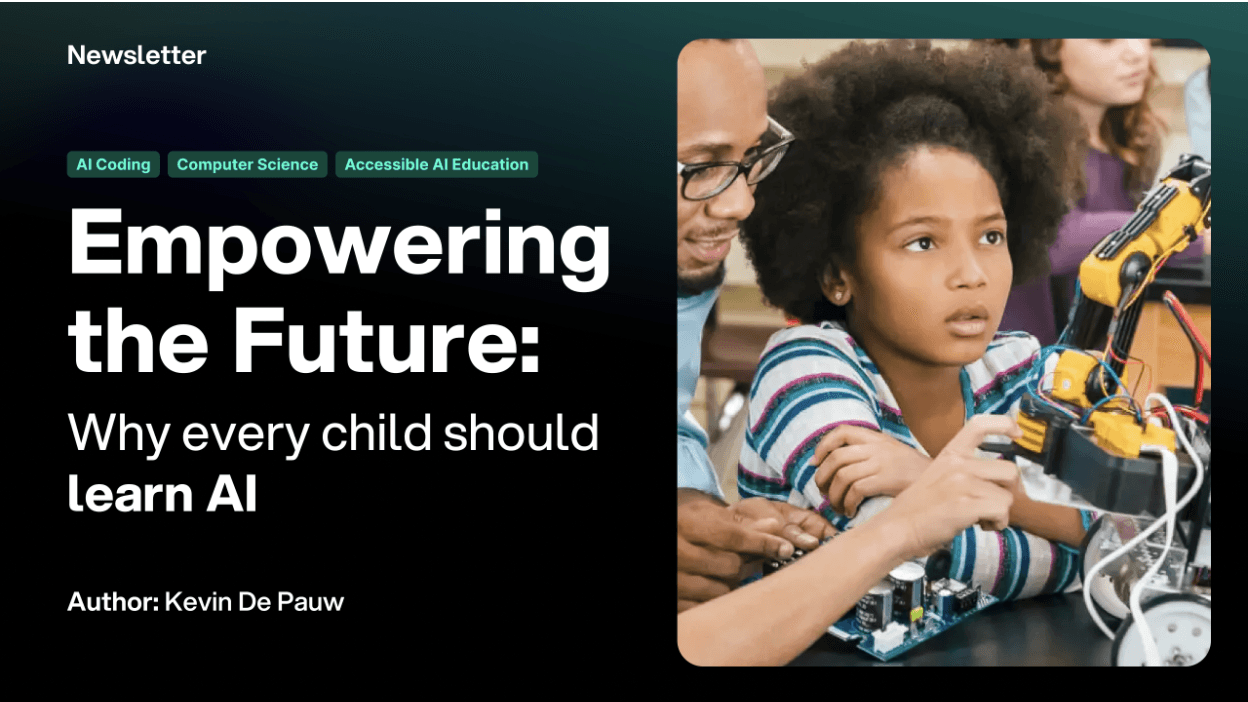
Empowering the Future: Why Every Child Should Learn AI
Date:
Jun 23, 2023
AI’s capabilities have become headline news in recent months. From the Stable Diffusion image generation models that went viral last fall to the launch of OpenAI’s ChatGPT language generator in December 2022, all the way up until the recent signed AI Act in Europe, AI is defining our current moment.
But what we’re experiencing now is not a passing fad. This moment is preceded by many years of serious research and impressive breakthroughs. Through Google’s Search, AI has powered the way most people receive new knowledge for decades. Through services like Netflix and Spotify, it recommends what media they will watch next. It operates in hospitals, farms, and assembly lines. And, thanks to tools like ChatGPT, it is increasingly automating white-collar work, too.
A recent research paper on the potential impact of Large Language Models (LLMs) like those underlying ChatGPT suggests that around 80% of the US workforce could have their workflows impacted by AI.
Meanwhile, 83% of executives say AI is a strategic business priority. The tools, techniques, and models we are seeing today will play a crucial role in building the world of tomorrow, with a potential add up, according a report of McKinsey, $4.4 trillion a year to the global economy.
We must educate ourselves for an AI-powered world
In today's rapidly evolving world, artificial intelligence (AI) is playing an increasingly crucial role in shaping our lives. From enhancing processes to analyzing data, AI has become a powerful tool for adults. However, it is time to recognize that AI education is not just for grown-ups. We must equip our children with AI knowledge from a young age, breaking down the boundaries between generations and preparing them for a future where AI will be omnipresent. By embracing technology early on, children can contribute to the betterment of society and pave the way for their own success.
Fostering Foundational Understanding and Skills
Introducing AI education to students at a young age is essential in developing their foundational understanding of this transformative technology. Early exposure to AI stimulates curiosity, creativity, and a growth mindset, fostering a lifelong love for learning. By comprehending the potential and limitations of AI, students become empowered users and contributors to AI-driven systems. AI education also cultivates computational thinking, problem-solving abilities, and logical reasoning, which are critical skills in the digital era.
Preparing Students for the Future
AI education equips students with valuable skills that are increasingly in demand across various industries. The jobs of the future will heavily involve working with AI technologies or collaborating with AI-driven systems. By providing students with AI literacy, they gain the ability to critically analyze information, identify biases, and make informed decisions in their personal and professional lives. Moreover, understanding AI enables students to leverage technology for social good and contribute to solving global challenges. It nurtures an entrepreneurial mindset, encouraging them to explore innovative solutions and drive economic growth.
IMAGE 1-

Content 2 -
Creating Inclusive and Accessible AI Education
Implementing AI education in schools comes with challenges. However, ensuring its accessibility to all students is crucial. Steps can be taken to offer equitable access to technology and internet connectivity in schools and communities. Financial support or scholarships can be provided to students from disadvantaged backgrounds. Collaboration with non-profit organizations, government agencies, and private companies can sponsor AI education initiatives in underprivileged areas. Additionally, partnerships with community organizations and libraries can offer AI learning programs beyond school hours.
Designing an Engaging AI Curriculum
An inclusive and engaging AI curriculum is essential to captivate students' interest. By integrating AI with subjects like mathematics, science, and social studies, an interdisciplinary approach can be adopted. Hands-on projects and real-world applications of AI enhance practical understanding. AI-driven problem-solving activities promote creativity, innovation, and teamwork, fostering communication and critical thinking skills. Elements of ethical AI decision-making and responsible technology use should also be incorporated to instill thoughtful analysis and evaluation of AI's societal impact.
Supporting Teachers and Fostering Critical Thinking
Teachers play a pivotal role in AI education. Providing them with support and resources is crucial to effectively teach AI concepts. Professional development opportunities, workshops, and training programs can be offered to enhance their expertise. Partnerships with universities and industry experts can provide mentorship and guidance. Comprehensive educational materials, lesson plans, and online resources specifically tailored for AI education should be developed. Establishing networks and communities of practice enables collaboration and the sharing of best practices among teachers.
Long-Term Benefits of Integrating AI Education
Integrating AI education into the core curriculum holds significant long-term benefits. A workforce well-versed in AI will drive innovation, leading to economic growth and competitive advantage. AI-literate individuals can contribute to the responsible development and deployment of AI technologies, ensuring ethical and inclusive outcomes. Moreover, AI education fosters a society that can adapt to technological advancements and make informed decisions about AI adoption. It democratizes access to AI knowledge, reducing the risk of creating a technology divide. By embracing AI education as a culture of lifelong learning, individuals continuously update their skills to keep pace with evolving technologies. This creates a society that is agile, adaptable, and ready to leverage AI for sustainable development and ethical decision-making.
My conclusion: The integration of AI education into the core curriculum is not a luxury but a necessity in today's world. By introducing AI to every child, we provide them with the tools and knowledge they need to navigate the AI-powered future. Early exposure to AI cultivates curiosity, creativity, and critical thinking skills. It prepares students for future careers and empowers them to become responsible users and contributors to AI-driven systems. Overcoming challenges in implementing AI education requires collaboration, accessibility, and support for teachers. The long-term benefits are vast, from driving innovation and economic growth to creating a society that can responsibly leverage AI for the betterment of all.
As we embrace the potential of AI, let us remember that its true power lies not just in the technology itself, but in the minds and hearts of the individuals who wield it. By teaching AI to every child, we empower them to shape a future where technology serves humanity and bridges the gaps between generations. Together, let us embark on this educational journey and unlock the limitless possibilities that AI education holds for our children and the world they will inherit.