Stay informed
Newsletters
Compliance Isn’t the Roadblock — It’s the On-Ramp
Date:
May 12, 2025
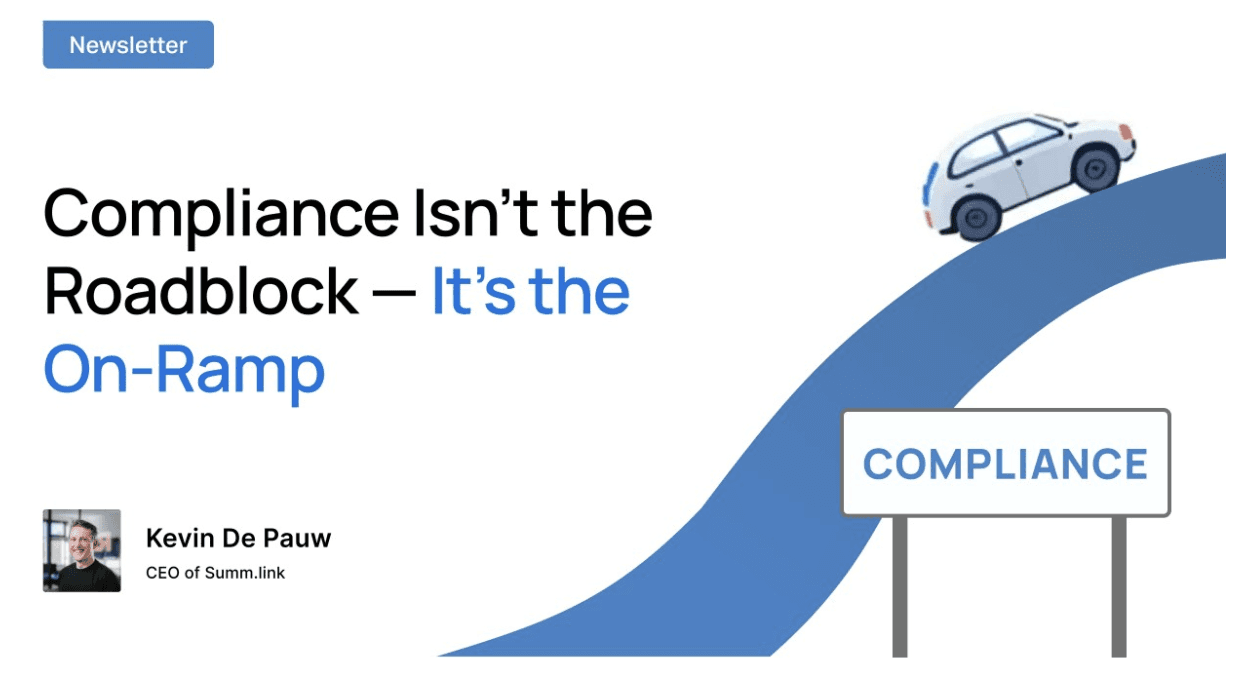
Compliance in business is exactly like those safety checks. It’s not a roadblock. It’s the on-ramp to a journey that’s fast, smooth, and—most importantly—sustainable.
In the startup world, compliance is often seen as a burden. It’s the paperwork, the bureaucracy, the thing you do right before a product launch (or worse, after something goes wrong). For many, it’s a box to be ticked—an afterthought. But this mindset misses the point.
In our latest LuminaTalks episode with Marc Dekeyser, we explored a critical truth: Compliance is not a bureaucratic obstacle. It’s a strategic advantage.
Marc, who’s spent years at Microsoft advising startups and scale-ups, explained it perfectly: “Compliance isn’t about avoiding penalties—it’s about building a company people can trust.”
This isn’t just about following rules. It’s about creating a culture where transparency, security, and accountability are baked into everything you do.
Imagine two companies, both scaling rapidly:
Company A treats compliance as a checkbox. It speeds ahead, releasing products quickly, but with every new market and every new user, it faces growing risks—data breaches, regulatory fines, unhappy customers.
Company B sees compliance as a foundation. It builds with transparency, ensures data protection is a core principle, and regularly audits its processes. As it grows, it doesn’t just gain customers—it gains their trust.
Which company do you think attracts better investors? Which one has a stronger brand reputation? Which one avoids the “crisis moment” that derails so many fast-growing businesses?
For most companies, compliance is a journey. But to make that journey smoother, it helps to know where you stand:
Reactive Stage: Compliance is a response to external pressure—regulators, customers, or incidents. It’s firefighting.
Proactive Stage: Compliance becomes part of the planning process. Teams consider data security, user privacy, and ethical standards before building.
Strategic Stage: Compliance is part of the company’s DNA. It’s not just about avoiding problems; it’s about gaining a competitive edge through trust and transparency.
Where are you on this curve? And where do you want to be?
Start Early, Scale Confidently: Don’t wait until you’re big to think about compliance. The earlier you embed it, the less painful it becomes later.
Make It Understandable: Compliance isn’t just for the legal team. Everyone—engineers, marketers, product managers—should understand the basic principles. Create a compliance culture that’s approachable.
Automate What You Can: In the age of AI, you don’t have to rely on manual checks and endless paperwork. Use tools to monitor data security, flag risky behavior, and generate compliance reports automatically.
Turning Compliance Into a Competitive Advantage
The companies that thrive in the next decade won’t be the ones that simply launch the fastest. They’ll be the ones that grow responsibly.
At Summ.link, we’ve built compliance into our DNA from day one. Whether it’s our AI products, our data practices, or our client partnerships, we operate with transparency, security, and accountability at the core.
And we’re not just doing this because it’s required. We’re doing it because it’s right.
The Compliance Checklist: Are You Ready?
If you’re thinking about your own compliance journey, start here:
Do you have a clear data protection policy?
Are you tracking regulatory changes (like the EU AI Act or GDPR updates)?
Do your team members understand their compliance responsibilities?
Are you proactively managing risks rather than reacting to them?
Are your systems designed with security and privacy by default?
Compliance is the On-Ramp, Not the Roadblock
If you want to build something that lasts, compliance is not just a legal requirement—it’s a strategic decision. It’s how you earn trust, attract investment, and scale without fear.
And the best time to start thinking about compliance isn’t at the point of crisis. It’s right now.
Let’s build responsibly. Let’s build with confidence.
What’s your approach to compliance? Are you treating it as a burden—or as a strategic advantage?
Interested in exploring more episodes of "AI Advances: Stay up-to-date"?
#34 The Hidden System That Holds Everything Together
#33 Integration Doesn’t Need to Be This Hard!
#32 Integration Fatigue Is Real—But It Doesn’t Have to Be
#31 Data Ecosystems Explained: The Lego Principle for Scalability
#30 Beyond Buzzwords: Data Governance in Practice
#29 The Future of AI Interoperability: What Businesses Need to Know
#28 What role does AI play in the future of workplace learning?
#27 How Do Data & AI Regulations Impact Innovation?
#26 Which AI skill is most valuable in 2025?
#25 Vertical AI is TRANSFORMING HR, and not REPLACING your job!
#24 Understanding Vertical AI and Multi-Agent Systems
#23 The Real Challenge of AI Adoption: Understanding the Problem Before Choosing the Solution
#22 Cache-Augmented Generation (CAG): Revolutionizing AI Efficiency, by replacing RAG
#21 Vertical AI – (R)evolutie na SAAS
#19 Business hebben, een walk in the park toch!? Of toch niet!?
#17 De markt staat in brand! Is er een War for Talent, War for Jobs of beide?
#16 Naar een Efficiëntere Overheid: Balanceren tussen Besparingen, Technologie en Burgergerichtheid
#15 Game Changer Alert: EU Supercomputers Open Doors for HR-AI Companies!
#14 Navigating the Changing Landscape in HR and Sales: How AI is reshaping Careers!
#13 Empowering the Future: Why Every Child Should Learn AI
#12 Trust as a Foundation: Unveiling Summ.link's ISO 27001 Certification and Its Impact | LinkedIn
#11 Introducing GPT-4 API: Empower Your AI Projects with Unmatched Performance
#10 Data science as a service (DSaaS)
#9 The Data-Driven organization: What it Means to Be One & Why it Matters!
#8 Explainable Artificial Intelligence (XAI) Frameworks for Transparent AI Systems
#6 The Benefits and Importance of People Analytics for HR and Talent Acquisition Teams
#5 Unlock the Power of People Analytics: Harness the Potential, Navigate the Challenges
#1 Exploring the World of Gen-AI: From Machine Learning to Language Models